

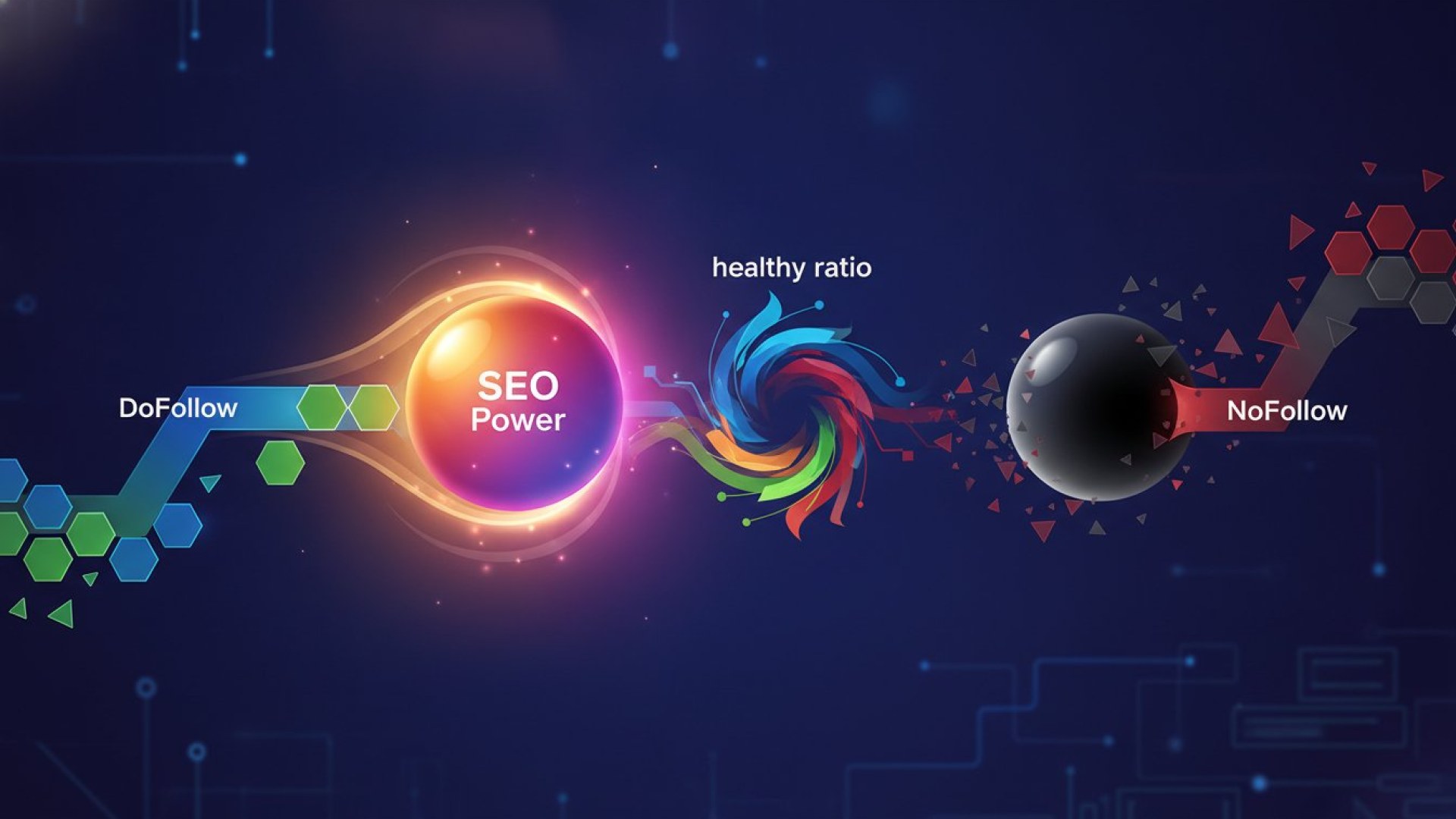
What Is the Difference Between Dofollow and Nofollow Links?
“Dofollow” usually means an ordinary link that has not been qualified with nofollow, sponsored, or ugc. Nofollow is a real rel value used when a publisher does not want Google to associate its site with the linked page or crawl it from that link.
The terminology can be misleading. HTML and Google’s documentation do not require rel="dofollow". In most cases, a normal editorial link looks like this:
<a href="https://example.com/research">original research</a>A nofollow link looks like this:
<a href="https://example.com/page" rel="nofollow">referenced page</a>Both remain links a person can click. The difference is the relationship information supplied to search systems—not whether the link visually works.
nofollow, sponsored, and ugc as hints. “Nofollow links never count” and “every followed link transfers a fixed amount of authority” are both oversimplifications.
Which Link Attribute Should You Use?
Use for a genuine editorial citation or recommendation when no qualification is needed.
Markup: A normal anchor with a usable href; no “dofollow” value is required.Use for advertisements, sponsorships, affiliate links, and other compensated placements.
Google guidance: Sponsored is preferred for paid links, although nofollow remains acceptable.Use for links within user-generated content such as comments and forum posts.
Option: Values can be combined, such asrel="ugc nofollow".Use when the other values do not apply and you would rather Google not associate your site with or crawl the linked page from that link.
Limit: It is not a privacy, access-control, or guaranteed no-index mechanism.More than one value can be supplied in the same rel attribute. For example, a paid link inside a community contribution can be marked rel="ugc sponsored". The values should describe the real relationship rather than being added to create a desired backlink-tool label.
How Does Google Treat Nofollow, Sponsored, and UGC?
Google says these attributes are hints about which links to consider or exclude within Search systems. That is different from the older shorthand that nofollow is always a command and that absolutely no signal can pass.
This does not make qualified links equivalent to ordinary editorial endorsements. It means an auditor should avoid claiming to know the exact treatment of an individual link. Google does not publish a link-by-link “equity” value, and third-party tools cannot observe Google’s internal calculation.
For a clearer explanation of what can and cannot be measured, see the link equity guide. Evaluate the source page, editorial purpose, placement, relevance, target, and surrounding pattern—not merely one attribute.
How Should Paid and Affiliate Links Be Marked?
Links created because money, goods, services, discounts, or another benefit changed hands should be qualified. Google recommends rel="sponsored" for advertisements and paid placements. An affiliate relationship is also a compensated relationship even when payment depends on a later conversion.
<a href="https://merchant.example/product" rel="sponsored">view the product</a>Using sponsorship is not an admission that advertising is improper. It separates commercial placement from independent editorial endorsement. Google’s spam policies identify buying or selling links for ranking purposes and advertorial links that pass ranking credit as examples of link spam.
Disclosure obligations for readers are a separate issue. The link attribute is machine-readable relationship information; it does not replace a clear sponsorship or affiliate disclosure required by the publisher’s audience, contract, or applicable law.
How Should Links in Comments and Forums Be Handled?
Google recommends rel="ugc" for user-generated links. This can help distinguish community contributions from links selected by the publisher. On a forum, marketplace profile, review, or comment area, combine the attribute with moderation and abuse controls.
Useful controls include:
- Holding new or suspicious submissions for review
- Rate limiting and detecting repeated promotional destinations
- Restricting links for new accounts where justified
- Removing compromised accounts and injected links
- Preventing profile, signature, and comment pages from becoming search-spam inventory
An attribute does not make a harmful page safe for users and does not replace moderation. If a link leads to malware, fraud, or irrelevant promotion, removal is usually more appropriate than merely adding nofollow.
Does Nofollow Prevent Crawling or Indexing?
No. Google says links marked with these values generally will not be followed, but the target can still be found through another site, an ordinary internal link, a sitemap, a redirect, or another discovery path. A nofollow attribute on one source page cannot control the target page.
Return a crawlable page with a supported noindex robots rule, then allow Google to fetch it and see the rule.
Require authentication or another real access control.
Do not: Treat robots.txt, nofollow, or noindex as security.Use redirects or canonicalization according to whether the alternate URL should remain accessible.
Do not: Use nofollow as a substitute for a canonical decision.Use an appropriate robots.txt rule when preventing fetches is the actual objective.
Tradeoff: A blocked URL can still be known and potentially appear without a snippet.Should Internal Links Be Nofollow?
Ordinary navigational and contextual internal links should normally be crawlable. They help people and crawlers reach the site’s pages, understand relationships, and find updated content. Adding nofollow to internal links in an attempt to “sculpt” PageRank can obstruct discovery without fixing weak architecture.
If a URL should not exist, remove or redirect it. If it must exist but should not be indexed, use an appropriate noindex rule. If several URLs represent substantially the same page, decide on redirects or canonicals. If a link performs an account action, implement it as a secure action rather than relying on nofollow.
Use descriptive anchor text that explains the destination. The anchor text guide covers internal wording and why artificial keyword ratios are not a sound objective.
Is target="_blank" the Same as Nofollow?
No. target="_blank" controls where a browser opens the destination. Values such as noopener and noreferrer relate to browser security and referral information. They do not mean sponsored, user-generated, or nofollow.
A paid external link opened in a new tab may therefore need both kinds of information:
<a href="https://example.com/offer"
   target="_blank"
   rel="sponsored noopener noreferrer">partner offer</a>
Select new-tab behavior for user experience and security, then select link qualification from the editorial or commercial relationship. Do not conflate them.
What Is a Healthy Dofollow-to-Nofollow Ratio?
There is no universal healthy percentage. A news organization, forum, software directory, affiliate publication, university, and local business naturally attract different types of links. A fixed target such as “70% dofollow” has no reliable basis and can encourage manipulation.
Tool-level ratios can also be distorted by:
- One sitewide footer or template link creating thousands of URLs
- Counting backlinks instead of distinct referring sites
- Forum, feed, scraper, and syndicated copies
- Historical links that have been removed or changed
- Different crawler coverage and attribute classification
- JavaScript-rendered or malformed links
A varied profile may be a natural consequence of genuine exposure, but variation itself is not proof of quality. Review the complete backlink profile and investigate suspicious clusters rather than trying to manufacture a cosmetic ratio.
How to Audit Followed and Qualified Links
- Export link-level data: Keep the exact source URL, target URL, anchor, first and last seen dates, status, and reported rel values.
- Separate links from referring domains: A thousand links from one template are not a thousand independent endorsements.
- Verify the live source: Fetch or open representative pages and inspect rendered HTML. Tool indexes can be stale.
- Classify the relationship: Editorial, paid, affiliate, UGC, directory, sitewide, owned-site, scraper, or unknown.
- Check placement and context: Main content, author bio, navigation, footer, comment, hidden element, or injected block.
- Inspect the destination: Confirm whether it resolves, redirects, returns an error, or points to a historically unrelated URL.
- Investigate patterns: Repeated anchors, unrelated languages, coordinated sites, paid-placement footprints, and abrupt bursts deserve source-level review.
- Record uncertainty: Do not convert a crawler’s incomplete observation into a claim about Google’s treatment.
Many SEO tools label a link “dofollow” simply because they did not detect a qualifying rel value. Confirm the live markup and remember that this label does not measure importance, editorial independence, traffic, or ranking impact.
How Do These Attributes Affect Expired-Domain Research?
For a previously used domain, the current followed-link count is only one part of due diligence. Historical context matters because ownership, content, URLs, and relationships may have changed.
Check:
- Whether important source pages and links still exist
- Whether the links were editorial, paid, user-generated, or sitewide
- Whether the destination can be restored legitimately and usefully
- Whether anchors and surrounding content match the domain’s historical purpose
- Whether a redirect chain now leads somewhere unrelated
- Whether reported links come from compromised, generated, or low-quality pages
A high followed percentage does not make a domain authoritative, and a mixed profile does not make it defective. Use the authority-link review and treat third-party spam scores as investigation prompts rather than verdicts.
Common Dofollow and Nofollow Mistakes
- Adding a nonstandard
rel="dofollow"value to ordinary links - Calling nofollow an absolute command rather than a Google hint
- Leaving paid or affiliate placements unqualified
- Using nofollow for every external citation regardless of relationship
- Using nofollow to hide a page from search results
- Blocking a noindexed page in robots.txt before Google can see the rule
- Nofollowing useful internal navigation to sculpt authority
- Treating
noopener,noreferrer, andnofollowas interchangeable - Optimizing a backlink ratio instead of investigating sources and patterns
- Assuming a tool’s current attribute label proves historical or Google-specific treatment
Primary Sources
- Google Search Central: Qualify outbound links
- Google Search Central: Link spam policies
- Google Search Central: Make links crawlable
- Google Search Central: Block indexing with noindex
sponsored, identify community links with ugc, and reserve nofollow for other relationships you do not want Google to associate with. Do not use link attributes as a substitute for access control, indexing directives, good internal architecture, or source-level backlink review.